First, let me state for the record, that the title of this post will be the last reference to Jane Austen I make.
...or not.
In our travels, we have seen many expressions of how people choose to pursue the nomad life. Some, like us, have reasonable budgets, enough to afford to travel in relative luxury. A few, have much greater monetary means, and as such, travel in large, luxuriant Class As (‘motorcoaches”), or much larger 5th wheels, like ours.
Class A..

Some of these motorcoaches can exceed $1,000,000!
5th wheel…

This is a near-twin to ours.
Some utilize what are euphemistically called, “Toy haulers,” some examples of which are seen in the link below.
https://blog.campingworld.com/find-your-rv/best-toy-haulers/
We gave some thought to this kind of 5th wheel, but one large enough to haul the Maverick would have topped out at 50 feet in length, which would be extremely difficult to get into many parks: some don't allow anything longer than 40 feet. Even then, when you discount the space needed for said toys (or back porch), you end up with less Lebensraum than our 35 foot trailer, not to mention the decreased maneuverability and decreased fuel mileage.
Quite a few folks use what’s known as a Class B: This is a standard van, like a Ford Transit, or Mercedes Sprinter, that has been kitted out inside for camping.
Bs usually have no slideouts, but have the advantage of being very maneuverable, and (relatively) fuel-efficient. They are also not much longer, overall, than 20 feet, so can get into smaller spaces, or, if 4WD, have a bit of off-road utility.
A representative Class B…

Then, there are Class Cs, which are usually van-based, but with the ‘box’ part removed, and an RV body attached. They are almost as maneuverable and as fuel-efficient (which ain't saying much!) as Class Bs, but definitely offer more room.
A Class C….

There is a subclass of Class Cs, called, “Super Cs,” which are based on larger pickup truck chassis, like Ford F550)s, or even larger, based upon OTR (over the road) semi-trucks, sometimes called ‘prime movers.’
A Super C…

The other common platform is a bumper-pull trailer, which are more difficult to maneuver than a 5th wheel, but offer the advantage of all the living room being on one level.
One of the odd things in the RV world is the terminology ("The secret handshake!”): Bumper pulls are often referred to as ‘tow-behinds,’ but 5th wheels also get ‘towed behind.’
¯\_(ツ)_/¯

We went round and round about which of these to choose, and ultimately chose the 5th wheel, for many reasons.
- Cost: used Super Cs can easily price out at $200,000+, so that wasn't an option; standard Cs are pretty popular, but I’ll circle back to why we didn't choose one.
- Utility: 5th wheels are quite plentiful, and consequently, well-priced.
- Backup ability: with a 5th wheel, the towed vehicle can actually pivot more than 90 degrees, whereas a bumper pull is limited to quite a bit less pivoting ability, making them much harder to back into spots, which is a fairly common occurrence in many RV parks.
- Ease of maintenance: any trailer can be serviced and fixed, relatively easily. They aren't terribly complex, so that becomes a point of interest, for me. However, As/Bs/Cs, being a combination of the living quarters and the motive source, if something goes wrong with the mechanicals (engine, transmission, drivetrain), and you need to take it to a service center for that repair, you're now homeless….!
Why not a standard C? Most Class Cs are based on chassis that utilize gasoline engines, and the weights they run at, make the engine work very hard, decreasing the life of the engine, with a concomitant decrease in fuel mileage. If they had diesel engines, I’d have considered one: the only ones that do come with diesel engines are Mercedes, and they are crazy expensive, and their reliability isn't all that great. plus, there are a boatload more Ford, Chevy, and Dodge dealers in the hinterlands than there are Mercedes dealers!
Diesels, by design, are much better suited to carrying heavy loads, and get better fuel mileage than a gasoline engine, in the same chassis.
There is also the facf that..I’m 69! I can still change a tire on The Beast, or the trailer, but on a A/C/Super C? Fuggeddibouddit!
As it is, to get the spare up and down, off the bed of The Beast, I had to rig up a stowable crane: I discovered when getting ready for the adventure, I can:
- lift a tire, or,
- I can lift a wheel, but;
- I cannot lift a tire AND wheel, as a unit!
These tire/wheels weigh around 190 pounds (86 kg): an A/Super C wheel/tire, can easily scale in at over 300 pounds (136 kg). If I blow a tire, on the highway, with our rig, I can change it: if that happened on a bigger rig, it’s a $peciality $ervice call, which can range up to $1000-$2000. Not only can a blown tire blow a hole in your budget, but it can blow a serious hole in your travel plans.
Plus, the tires on an A/Super C can cost upwards of $800-$1000, per tire. I got all four rear tires of The Beast replaced for $1500.
Ah..more secret handshake stuff—duallies!
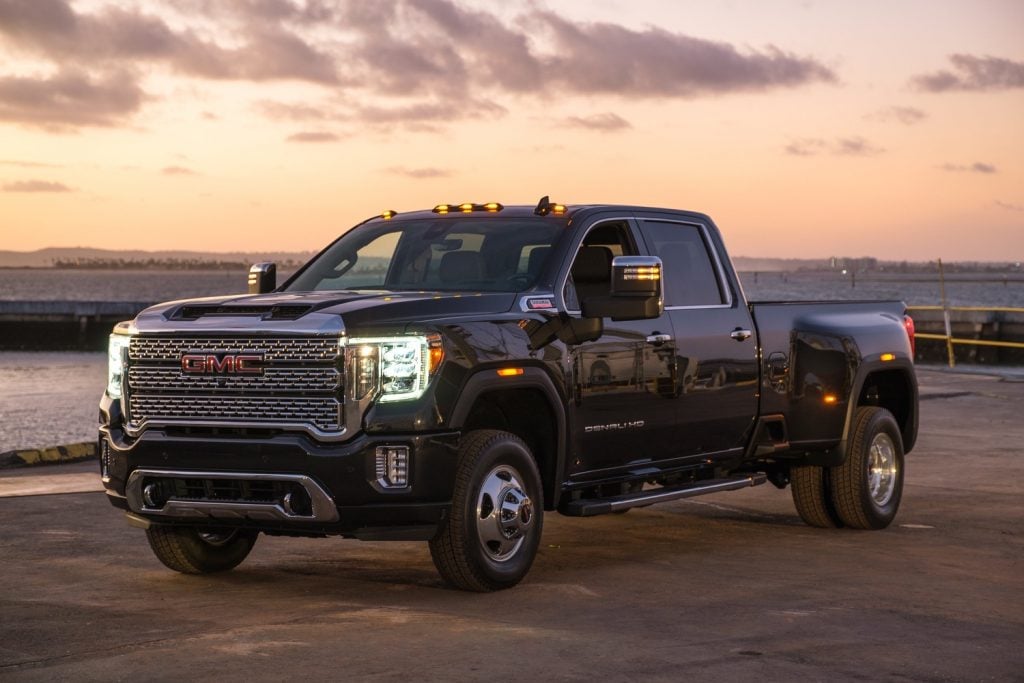
Why even have a dually? Good question, Grasshopper!
Tires have load limits, and when towing, especially large, heavy loads, you must take into account how much load each tire can support. That is, not only is the weight of the vehicle, but the weight the truck is carrying.
Here are the numbers...
The Beast weighs a total of 11,200 pounds (5090kg), with a 50/50 weight distribution: that’s 5600 pounds (2545 kg) per axle (axle is defined as a set of wheels, left to right, regardless of the number of tires) With the trailer on, the rear axle weight increases to 11,460 pounds (5209 kg).
Each tire has a maximum load rating of 3750 pounds (1704 kg) for a total carrying capacity of 15,000 pounds (6818 kg). That leaves a safety margin of 3540 pounds (1568 kg). Thats a good safety factor. Were we to use a non-dually truck, you can see the issue!
It would carry it, but the tires would be signifcantly overloaded: not an issue for a few miles, but going down highways, especially in the hot times of the year?
POP!!
Tires, as they do their work, generate heat, and excess heat is the main killer of tires. For that reason, even though I’m safely under the carrying capacity of the tires, if—I pray it never happens, by ALWAYS using proper pressures—stuff happens, the duallies give us ‘backup,’ It’s not at all common for both tires to go pop, simultaneously, but if a single tires does, one can limp along on the remaining tire, to somewhere to get it replaced. On a non-dually, truck? You're stopping RIGHT there...and changing a tire. Doing so while the trailer is on is exceedingly difficult. Duallies give you a safety and comfort factor.
Back to why we chose a 5th wheel: along with the utility, and (relative) ease of backing, we knew this was going to be our home. It wasn't just a weekend jaunt, or even a short two-week journey: we were going to live in it, full-time. A 5th wheel gives you that room, it is fairly maneuverable, competitively-priced, and at the size point we chose, almost all RV parks are able to accommodate it.
Could we have lived in a C or a B? Yea…my wife and I like each other’s company..BUT….we knew that living, cheek-by-jowl, would put a strain on things. A 5th wheel (or any like-sized RV) gives you the ability to ‘escape’ to opposite ends, to do things that would be more difficult to do in a smaller RV.
So there ya have it: Sense, and Sensibility.
Sense, to grasp fully our choices, and do the correct thing that fits lifestyle choices, and sensibility (“the capacity to respond intelligently, to refined emotions”) to choose wisely.
In our 14th month of living the vida mobile, it seems to have been the correct one!
Stay tuned for more! Feel free to leave any questions and comments on the blog, and we’ll respond as quickly as possible.


Such a thorough & thoughtful explanation! I don’t think Jane Austin would mind having her name attached to this, at all!
ReplyDelete